
Fleur-de-lys Tummy tuck

Fleur-de-lys Tummy tuck

NEWMARKET PLASTIC SURGEON SERVING TORONTO AND GTA

DR. WILLIAM ANDRADE

Disclaimer: Some images on this website feature professional models and are intended for illustrative purposes only. They do not represent actual patients or guaranteed treatment outcomes.

OVERVIEW

A fleur-de-lys tummy tuck (is a procedure that is done for patients with very loose skin on the abdomen; for example, after major weight loss or large weight swings during pregnancy.  Unlike a regular tummy tuck which essentially removes a large wedge of excess skin located on the lower abdomen then re-drapes the abdominal tissue to close the wound, a fleur-de-lys tummy tuck also removes a large vertical ellipse of skin from the abdomen.  This results in more tightening of the abdomen and sides of the body, but results in more scars.   There is a vertical midline scar plus a lower a lower abdominal scar.  For patients who are not concerned about visible abdominal scars but want the tightest abdominal result possible, the fleur-de-lys abdominoplasty may be the best option.   Dr. Andrade always does a full in-person assessment so he can explain the advantages and limitations of different tummy tuck procedures.  The goal is to provide the operation that best meets the patient’s expected outcome, while taking into consideration important factors like the location and amount of loose skin, tolerance of scars and risks, procedural costs and recovery time.

CONSULTATION

The consult with Dr. Andrade starts by taking a detailed medical history and understanding the desired cosmetic result.  The physical examination involves determining the amount of fatty tissue present, tone of the overlying skin, assessing for a hernia, rectus diastasis or abdominal mass.  Dr. Andrade will then offer an opinion whether a fleur-de-lys tummy tuck is likely to achieve the desired outcome, or whether a less invasive operation would be suitable.

DAY OF SURGERY

A fleur-de-lys tummy tuck is done under a full general anesthetic, so patients must fast the night before.  All anesthetics are delivered by a fellowship-trained anesthesiologist.  The duration of surgery is typically about 4 hours, and patients are often discharged home afterward.

POSTOPERATIVE RECOVERY

Most patients report only moderate pain, which is managed by over-the counter or prescription analgesic medications.  We encourage patients to get up and ambulate around their home the same day as their procedure, to decrease the risk or respiratory complications or a clot in the legs (deep vein thrombosis, DVT).   An abdominal compression garment called a binder is worn for 3-4 weeks postoperatively to decrease postoperative swelling.  After this time, some patients continue to wear a conforming garment (girdle or faja) for another 3-4 weeks.   We apply an antimicrobial dressing that is usually left on for about 5 days, after which time showering can resume.   Avoid soaking in a bath tub, hot tub or pool for several weeks until the incisions are well-healed.

Bruising and swelling are common after fleur-de-lys abdominoplasty surgery.  Bruising is usually gone by about 3 weeks, but intermittent swelling can persist for up to a year.

Most patients return to work within 3-4 weeks after fleur-de-lys tummy tuck surgery, but for 6 weeks they should avoid lifting over 10kg, or activities involving repetitive squatting, bending, twisting or overhead reaching.

BENEFITS, RISKS AND ALTERNATIVES TO FDL TUMMY TUCK SURGERY

The majority of patients having fleur-de-lys abdominoplasty surgery will not have a complication, but every surgery has risks.  Bleeding, subcutaneous fluid collection called seroma, infection, and abnormally thick scars (keloids) can develop postoperatively.   Rarely, major organs, nerves or blood vessels could be injured.  Having a general anesthetic for any procedure entails the risk of dental damage, windpipe (trachea or vocal cord) injury, extremity numbness, DVT, allergic reactions or other problems.  Aesthetic surgery is not an exact science so the procedure can result in asymmetry and focal contour depressions.  


Alternatives to FDL abdominoplasty surgery include not having the surgery, or opting for less invasive nonsurgical or surgical procedures.

This information is intended to complement the advice of Dr. Andrade obtained during a proper consultation, and it is not guaranteed to be current, exhaustive or complete.

View Our

Media Gallery

Tummy Tuck Surgery

Full and Mini TT

Wound Drains

Common Questions About Abdominoplasty (Tummy Tuck) Procedures

Tummy tuck surgery is not an OHIP-covered procedure. Removal of loose skin on the the body is not covered by provincial insurance regardless of the cause (even after massive weight loss or previous surgery for obesity). Another abdominal procedure called “panniculectomy” may be an OHIP-insured procedure in certain patients who have a very large overhang of skin (called a “pannus”) on the lower abdomen.  In order to qualify for surgery, the patient must have evidence that the pannus causes serious problems like recurrent infections requiring prescription antibiotics. Panniculectomy surgery is not the same as tummy tuck surgery because it does not involve tightening the abdominal muscles or improve the appearance of the upper abdomen.  It simply involves removing the overhang of skin.

Ideally it is best to be at a steady weight prior to having abdominoplasty surgery.  This ensures that the maximal amount of skin can be removed.  If there is significant weight loss after surgery there can be some recurrent skin laxity, depending on each patient’s skin tone.  Some patients will still have an excellent contour.  This patient had a tummy tuck and was very happy with the appearance, but she was motivated to lose another 30 pounds postoperatively.  After this additional weight loss the abdominal contour was further improved.  The photos below show her appearance at each stage.
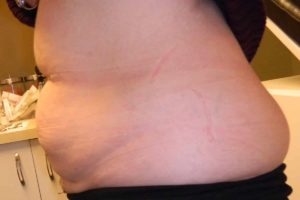
Before
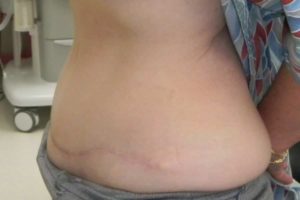
After Surgery
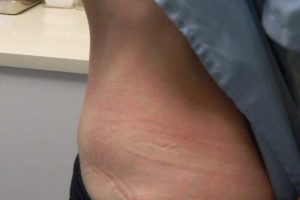
After Surgery + Weightloss

The outcome of tummy tuck surgery depends on each person’s existing anatomy, not just the procedure itself. The operation only removes excess skin and fatty tissue which is superficial to the muscles. Any abdominal bulging due to tissue deep within the body (organs or intraperitoneal fat) will not be correct. Patients who have lost weight and have loose, hanging skin and fat will typically see the most dramatic contour improvement. In contrast, those patients who have a tight, protruding, barrel-shaped abdomen will not have correction of the bulging contour. It is important to find before-and-after photos of people with a similar body shape as yours, to determine if you might be satisfied with the degree of improvement than can be realistically achieved.

“Hourglass abdominoplasty surgery” has the potential to substantially improve the overall abdominal contour, including the waistline. However, the operation does not change the bony structure, (like the shape of the ribs and pelvic bones) and it does not alter the muscles lateral to the abdomen. Patients who have pre-existing waist curvature will typically see this contour improved. Conversely, those patients who have a straight, trunk-like waistline before surgery likely will not achieve an hourglass waistline afterward. Dr. Andrade always does a thorough in-person consultation to assess each person’s unique anatomy (never delegating this important role to someone else), then he discusses the anticipated improvement that may be achieved.

Liposuction is an important addition to tummy tuck surgery, but it is not always desired or needed. This procedure enables the surgeon to target focal bulges (for example, on the upper abdomen and flanks) that might not be addressed by tummy tuck surgery alone. The degree of additional improvement is typically modest, perhaps removing 30-40% of the fat in a given area. The additional contour gains must be weight against the additional risks and costs of the procedure. Dr. Andrade does not automatically recommend liposuction for each patient, but rather he makes individualized recommendations based on each patient’s anatomy, goals and expectations.


Contact Us
  • Breast Implant
  • Breast Lift
  • Implant + Lift
  • Reconstruction
  • Lipofilling
  • Inverted Nipples
  • Face
  • Injectables
  • Tummy Tuck
  • Mini Tummy Tuck
  • Contouring, skin removal
  • Arm Lift
  • Thigh Lift
  • Skin Lesion Removal
  • Contouring, skin removal
  • Arm Lift
  • Thigh Lift
  • Tummy Tuck
  • Mini Tummy Tuck
  • Contouring, skin removal
  • Arm Lift
  • Thigh Lift
  • Skin Lesion Removal
  • Contouring, skin removal
  • Arm Lift
  • Thigh Lift